

Most tools in this space hand you a locked-down generator with a handful of house styles and a credit meter that drains the second you get specific. Civitai does the opposite. It is first a model-sharing community where creators dump checkpoints, LoRAs, embeddings, and workflows by the tens of thousands. The on-site generator is the convenient front end that lets you run them without local hardware. NSFW stays completely off by default; the site will look almost wholesome until you create an account, confirm you are an adult, and deliberately open the mature and explicit filters. That gatekeeping is the point. Once those toggles are live, the Civitai NSFW catalog becomes the deep end: thousands of specialized resources tuned for exact bodies, acts, lighting, and kinks that no single platform’s in-house models will ever match.
You land, you opt in, and the entire library reorients around what you actually want to generate tonight.
The Create button, the eye icon, and the first thirty seconds
Hit civitai.com or the unrestricted civitai.red front door. No account is required to browse SFW material or download public models. Sign-up is frictionless, Google, Discord, GitHub, Reddit, or email. The moment you are in, open account settings and find Content Moderation. Flip Mature Content (that confirms 18+) and Explicit/Adult Content. An eye icon appears in the top menu. Click it and enable the levels you want: R for partial nudity and adult situations, X for graphic nudity and genitalia, XXX for explicit acts. Turn off blur if you prefer the thumbnails uncensored. Refresh. The feeds, model cards, and search results rebuild around the ratings you chose.
The blue Create button lives in the top right on every page. It slides out the generator drawer, or you can go full-screen at /generate. From any model card that the creator has permitted for on-site use you can also hit Create and the resource loads pre-selected. Spot an image you like in the feed? Remix copies its prompt, seed, model stack, and settings straight into the generator. That is the arrival ritual: enable the filters, pick a model or remix something that already looks filthy, type, generate. No GPU required. It runs in the browser, even on a phone.
15,938 tagged models and what civitai nsfw generation actually delivers
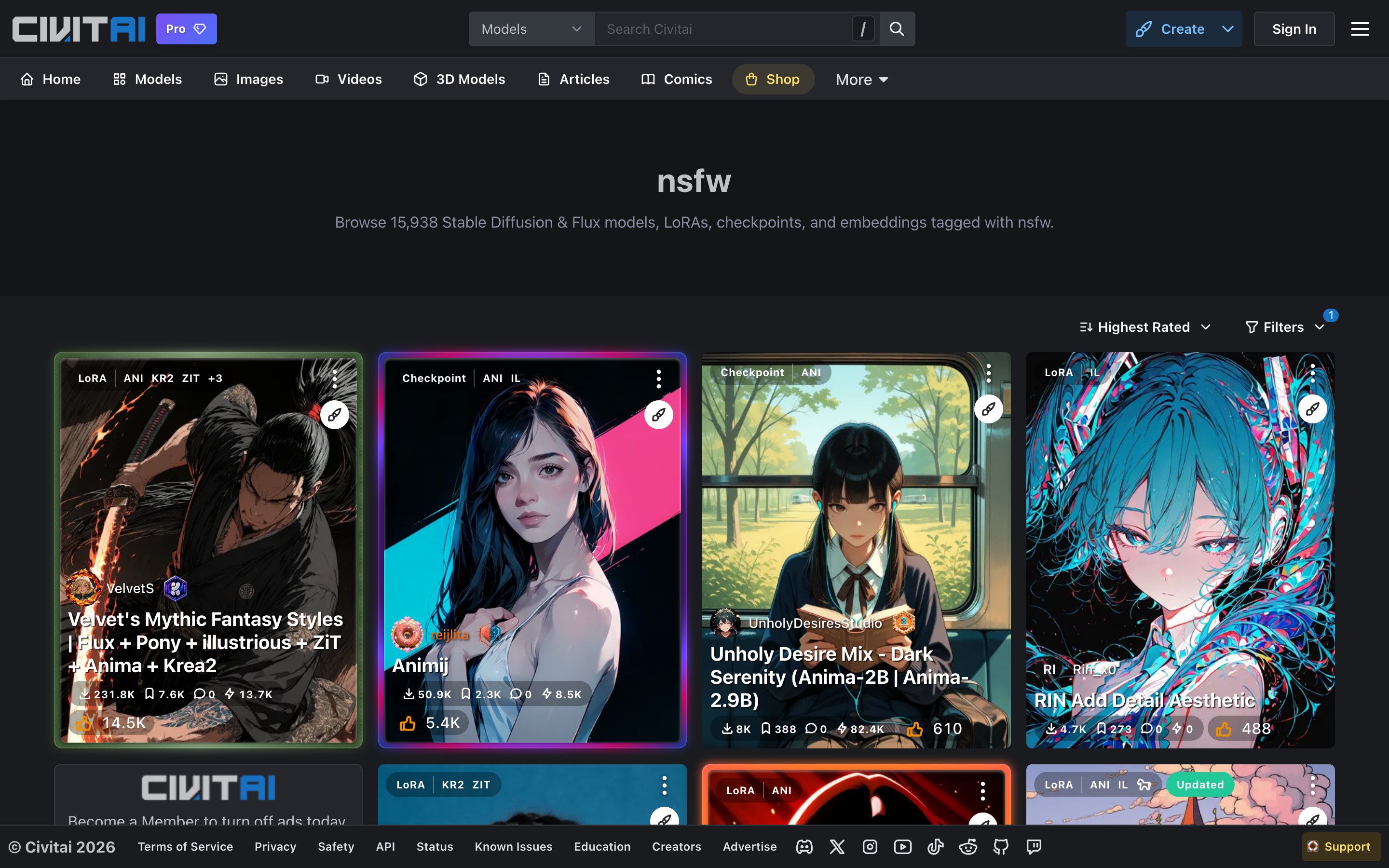
The nsfw tag alone surfaces 15,938 Stable Diffusion and Flux models, LoRAs, checkpoints, and embeddings. That number is only the tagged slice; the real catalog is larger once you filter by base model, highest rated, most downloaded, or newest. Checkpoints give you full foundations, Pony, Illustrious, Anima, various SDXL and Flux fine-tunes that already lean hard into anatomy and skin. LoRAs layer the specifics: body types, facial features, clothing destruction, lighting setups, pose libraries, fluid physics, expression packs. Embeddings handle the tiny conceptual nudges. Stack them. The generator lets you add multiple additional resources; each one past a certain size and count adds a small Buzz premium according to a transparent formula, but the creative control is the point.
Quality tracks the resource quality. Good creator cards ship example images with full generation data, prompt, negative, seed, sampler, steps, CFG, so you can reverse-engineer exactly what produces those glistening highlights or that particular stretch of skin. The on-site engine supports the common bases and keeps adding newer ones. Aspect ratios cover square, portrait, and landscape at the native resolutions for each architecture (512-range for older SD 1.5 lines, 1024-range for SDXL and kin). Draft mode trades a bit of fidelity for speed and lower cost when you are iterating a prompt. Full runs give you the detail: pores, wetness, muscle tension, fabric strain. Face-fix and hi-res-fix workflows sit one menu deep, ADetailer-style face repair plus a second-pass upscale that sharpens without turning everything into plastic. After generation you can upscale further 1.5×, 2×, 2.5× or 3× with the 4x Foolhardy Remacri model for a modest extra Buzz spend. Finished images that you do not post stick around for 30 days; download the zip or post them to your profile or the resource gallery to keep them longer and feed the creator economy.
Generation costs Buzz. The meter is visible before you commit. Simple SD 1.5 style runs sit at the low end; heavier SDXL, Pony, Flux, or multi-LoRA stacks climb. Extra resources over certain size thresholds add incremental Buzz on a clear curve, one to three extras might add a single Buzz, heavier stacks add more. You see the total before you hit generate. Queue behavior and concurrent jobs scale with membership. Free users work with the daily allotment plus whatever they earn; paid tiers unlock higher images-per-job (8 on Bronze, 10 on Silver, 12 on Gold), more queued jobs, and free high-priority generation so you are not staring at a spinner while the site is busy.
The real difference is the long tail. Want a very specific body modification, a particular sheen on skin under neon, an exact camera angle on an act that most platforms soft-ban? Someone has almost certainly trained a LoRA for it, documented the trigger words, and uploaded example grids. You load it, weight it, combine it with a strong base, and the output lands closer to the mental image than any closed generator’s “sexy” preset. That is the civitai nsfw advantage: the community keeps training the edges that product teams will never green-light.
Remix, workflows, and the metadata that makes every image a lesson
Remix is the fastest way to learn. Every public generation that includes metadata becomes a free masterclass. Click it and the entire recipe loads, base model, every LoRA with its weight, the full prompt and negative, sampler, steps, seed. Tweak one variable and regenerate. In an evening you can reverse-engineer why one creator’s skin looks alive while another’s looks like polished plastic. Face-fix and hi-res-fix sit in the workflow menu for both text-to-image and image-to-image. Denoise strength gives you the usual control over how hard the second pass deviates from the first. The self-refund thumbs on failed outputs return a little Buzz and send signal back to the team. Job IDs make support actually useful if something breaks.
Civitai Link syncs resources to your local machine when you eventually want to leave the browser. Vault storage (membership-scaled) keeps private or deleted-from-public models available so a favorite LoRA disappearing from the site does not brick your workflow. Private models let you train or upload without putting everything on the public feed immediately.
Buzz, daily claims, and the creator loop that keeps new filth arriving
Buzz is the single currency. Free users claim a daily amount just for opening the generator, then earn more by reacting to images, posting their own, leaving feedback, and (if ads are on) viewing ads up to daily caps. Membership multiplies the daily rewards and dumps a large monthly Green Buzz allotment on top. Creators earn a cut when their resources get used in generations, plus optional tips and the newer licensing-fee system where they can set a per-image price that stacks. Higher membership tiers raise the caps on what creators can charge for paid access or licensing. The result is a self-reinforcing loop: good NSFW models get used, creators get paid in Buzz or cash-out paths, more specialized models appear. You benefit every time you generate.
Bronze at ten dollars, Silver, Gold, and what the free tier still hands you
Free gets you the entire public model library for download, full browsing once filters are set, the on-site generator, and whatever Buzz you claim or earn each day. Ads appear. Queues are standard priority. It is enough to explore, test a handful of LoRAs, and decide whether the output quality justifies spending.
Bronze is $10 per month: 10,000 Green Buzz, 5% bonus on purchases, 1.5× daily Blue Buzz rewards, 3 private models, 8 images per job, 8 queued jobs, free high-priority generation, ad-free browsing, Civitai Link, priority support, badge, early features, and Creator Program access with higher licensing caps. Silver at $25 lifts the monthly Buzz to 25,000, private models to 10, images per job to 10, queued jobs to 10, and improves the bonuses and support tier. Gold at $50 delivers 50,000 Green Buzz, 100 private models, 12 images per job, the highest multipliers, animated badge, and the loosest creator pricing ceilings. You can also buy perks-only memberships with Buzz (no monthly Buzz dump, no auto-renew) or gift tiers. On the red side, Yellow Buzz purchased with crypto powers unrestricted generation; Green Buzz stays tied to safer content. Memberships purchased on the main site carry priority and limits across both doors.
The upgrade is not about unlocking the catalog, the catalog is already open. It is about removing friction: more images per run, priority so generations finish while the idea is still hot, enough Buzz that you stop rationing every LoRA stack, and the private storage that lets you keep the weird custom stuff only you use. Heavy nightly sessions burn through free daily Buzz fast once you start combining high-step SDXL or Flux runs with multiple resources. Bronze alone turns that into a non-issue for most people.
The library that keeps paying off after the novelty fades
A month in, the membership badge and the extra queued jobs are nice. The feature that still matters is the living model library itself. New LoRAs and fine-tunes drop constantly. The ones that nail a previously impossible combination of anatomy, lighting, and act get downloaded, remixed, and improved by the next creator. Your prompt vocabulary grows because every strong image teaches you the exact tokens and weights that work. Local generation becomes optional rather than mandatory; when you do go local, Civitai Link and the Vault mean you already own the resources. Everything else, priority queues, monthly Buzz dumps, private model slots, is decoration next to that endless, community-trained supply of precisely filthy image models.